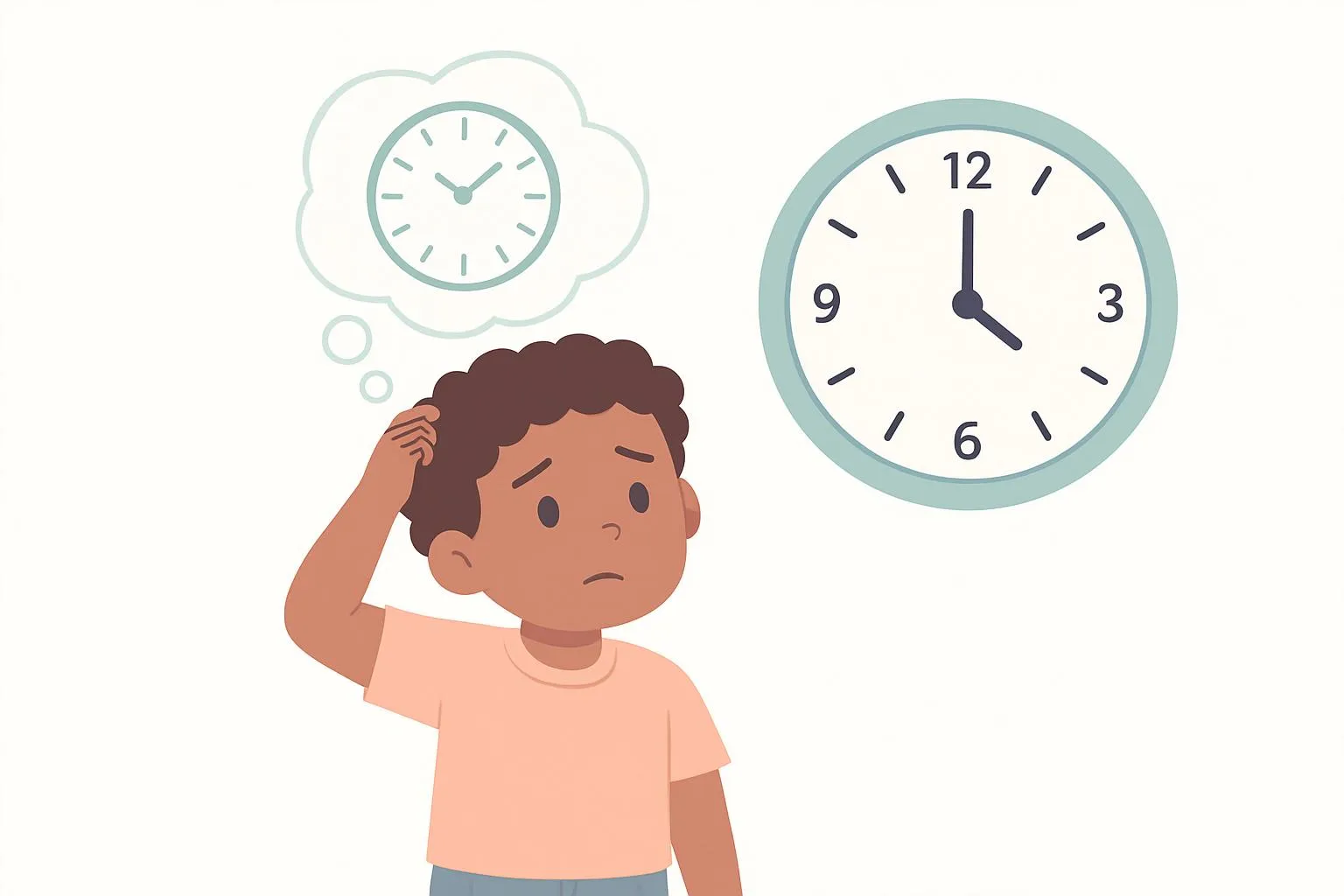
Understanding Common Time-Telling Mistakes
Every child learning to tell time makes mistakes—it's a natural part of the learning process. However, recognizing these common errors early and addressing them with targeted strategies can accelerate mastery and prevent frustration. This guide identifies the five most frequent mistakes children make when learning to tell time and provides practical solutions for each.
Mistake #1: Confusing the Hour and Minute Hands
What It Looks Like:
Students read the time backwards, saying "15:03" instead of "3:15" or "30:12" instead of "12:30". They may consistently use the minute hand to determine the hour and the hour hand for minutes.
Why It Happens:
- Visual Similarity: Both hands look similar, especially on small clocks
- Lack of Understanding: Child doesn't grasp that different hands serve different purposes
- Rushed Learning: Moving too quickly without establishing hand recognition
- Insufficient Practice: Not enough repetition to build automaticity
How to Fix It:
Strategy 1: Dramatic Differentiation
- Use clocks with highly contrasting hand lengths
- Color code: blue for hour hand, red for minute hand
- Label hands directly: write "HOUR" on short hand, "MINUTE" on long hand
- Use demonstration clocks with exaggerated size differences
Strategy 2: Verbal Reinforcement
- Create memorable rhymes: "Short and slow shows the hour we know"
- Always say: "The SHORT hand shows the HOUR"
- Before reading time, ask: "Which hand is the hour hand?"
- Practice identifying hands before reading any times
Strategy 3: Isolated Practice
- Use clocks with only one hand initially
- Practice reading just hours with only the hour hand visible
- Add minute hand only after hour hand mastery
- Create worksheets focusing on hand identification
Activity: "Hand Detective" - Show various clocks and have students identify which hand is which before attempting to read the time.
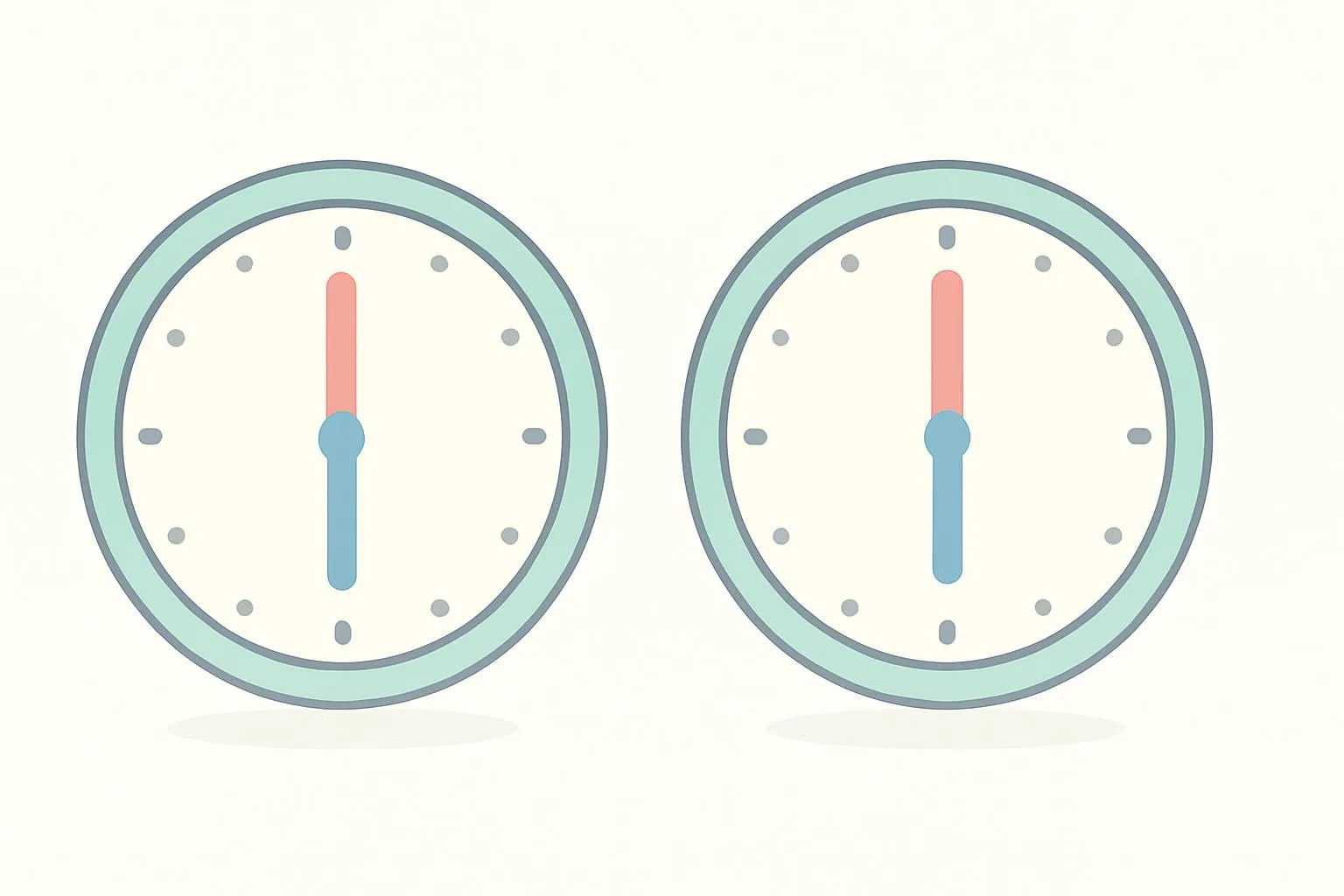
Mistake #2: Reading the Hour Hand Incorrectly When It's Between Numbers
What It Looks Like:
When the time is 3:45, students say "4:45" because the hour hand is close to the 4. This is one of the most persistent errors in time-telling.
Why It Happens:
- Misconception: Child thinks hour hand jumps from number to number
- Focus on Proximity: Reads whichever number the hour hand is closest to
- Lack of Understanding: Doesn't realize the hour hand moves gradually
- Digital Clock Influence: Digital clocks show hour changes instantly
How to Fix It:
Strategy 1: Demonstrate Gradual Movement
- Show how the hour hand moves slowly throughout the hour
- Use a demonstration clock to move through a full hour
- Explain: "The hour hand travels from 3 to 4 during the 3 o'clock hour"
- Create a visual showing hour hand positions at :00, :15, :30, :45
Strategy 2: The "Between Rule"
- Teach: "When the hour hand is BETWEEN two numbers, use the SMALLER number"
- Practice identifying: "Is the hour hand between 3 and 4? Then it's 3-something"
- Use the phrase: "The hour hand hasn't reached 4 yet, so we're still in the 3 o'clock hour"
- Create visual aids showing the "between zone"
Strategy 3: Targeted Practice
- Focus specifically on times like :45 and :50 where confusion is common
- Use worksheets from our generator featuring these challenging times
- Compare pairs: Show 3:45 and 4:45 side by side
- Practice with real-time observations throughout the day
Activity: "Hour Hand Journey" - Draw the path of the hour hand through one complete hour, marking positions at each quarter hour.
Mistake #3: Difficulty Counting by Fives Around the Clock
What It Looks Like:
Students struggle to determine minutes because they can't reliably count by fives. They may count by ones (taking too long) or skip count incorrectly.
Why It Happens:
- Prerequisite Gap: Skip counting by fives isn't automatic yet
- Number Confusion: Doesn't connect clock numbers to minute values
- Cognitive Load: Too many steps to remember simultaneously
- Lack of Practice: Insufficient repetition of the counting pattern
How to Fix It:
Strategy 1: Build Skip Counting Foundation
- Practice counting by fives daily, separate from clock work
- Use songs and chants: "5, 10, 15, 20..."
- Create number lines showing the pattern
- Don't proceed to minute reading until skip counting is automatic
Strategy 2: Label the Clock
- Write minute values around the clock: 5, 10, 15, 20, 25, 30, 35, 40, 45, 50, 55, 60
- Use different colors for hour numbers (blue) and minute numbers (red)
- Create reference posters for classroom walls
- Provide individual labeled clocks for student desks
Strategy 3: Systematic Practice
- Practice counting around the clock daily
- Point to each number while counting by fives
- Start at different positions, not always at 12
- Use physical movement: walk around a floor clock while counting
Activity: "Clock Hop" - Create a floor clock with numbers. Students hop to each number while counting by fives.

Mistake #4: Confusing "Past" and "To" Language
What It Looks Like:
Students say "quarter to 3" when they mean "quarter past 3" or struggle to understand what "20 minutes to 4" means. This linguistic confusion is especially common with times after the half hour.
Why It Happens:
- Abstract Language: "Past" and "to" are abstract concepts for young children
- Directional Confusion: Doesn't understand the clock as a circular timeline
- Multiple Representations: Same time can be said different ways (3:45 = quarter to 4)
- Cultural Variations: Different regions use different time language
How to Fix It:
Strategy 1: Visual Division
- Divide clock face in half vertically through 12 and 6
- Color right half green (past) and left half yellow (to)
- Teach: "Right side = past the hour, Left side = to the next hour"
- Use consistent language: "We're past 3" or "We're heading to 4"
Strategy 2: Start with Digital Format
- Initially teach digital time reading (3:45) before "quarter to" language
- Once confident with digital, introduce alternative expressions
- Show equivalence: "3:45 is the same as quarter to 4"
- Don't require "to" language for young learners
Strategy 3: Gradual Introduction
- Start with "past" only (quarter past, half past)
- Master "past" language completely before introducing "to"
- Introduce "to" only for quarter to (45 minutes)
- Advanced students can learn other "to" expressions later
Activity: "Past or To?" - Show various times and have students determine if they're in the "past" or "to" zone.
Mistake #5: Mixing Up AM and PM
What It Looks Like:
Students say it's 3:00 PM when it's actually 3:00 AM, or don't understand why we need AM/PM designations at all. They may think 12:00 PM is midnight.
Why It Happens:
- Abstract Concept: 12-hour cycle repeating twice daily is confusing
- Limited Experience: Young children aren't awake for both cycles
- Inconsistent Noon/Midnight: 12 PM/AM rules seem arbitrary
- Digital Dependence: Digital devices show AM/PM automatically
How to Fix It:
Strategy 1: Connect to Daily Routine
- Create visual schedule showing AM activities (morning/before lunch) and PM activities (afternoon/evening)
- Use phrases: "AM = After Midnight" and "PM = Past Midday"
- Connect to personal experience: "You eat breakfast at 7 AM, dinner at 6 PM"
- Use pictures: sun rising for AM, sun setting for PM
Strategy 2: Simplify the Rules
- Teach: "AM is morning time (midnight to noon)"
- Teach: "PM is afternoon and evening time (noon to midnight)"
- Special cases: "12 PM is lunch time (noon), 12 AM is bedtime (midnight)"
- Use memory tricks: "PM = Past Morning"
Strategy 3: Practice with Context
- Always provide context: "Is 3:00 in the morning or afternoon?"
- Use realistic scenarios: "School starts at 8:00 ___" (AM)
- Show 24-hour timeline with AM/PM marked
- Practice determining AM/PM for familiar activities
Activity: "AM/PM Sort" - Give students cards with times and activities. Sort into AM and PM categories.
Prevention Strategies: Avoiding These Mistakes
1. Proper Sequencing
- Follow systematic progression: hours → half hours → quarter hours → 5-minute intervals
- Don't skip steps or rush through concepts
- Ensure mastery at each level before advancing
- Use our worksheet generator to create appropriately leveled practice
2. Adequate Practice Time
- Provide 10-15 minutes of daily time practice
- Use varied activities: worksheets, games, real clocks
- Incorporate time-telling into daily routines
- Review previously learned concepts regularly
3. Clear, Consistent Language
- Use the same terminology consistently
- Avoid confusing phrases or multiple terms for same concept
- Model correct language when reading time
- Correct errors gently and immediately
4. Visual Supports
- Keep labeled clocks visible in classroom
- Use color coding consistently
- Provide reference materials students can consult
- Create anchor charts for common trouble spots
When to Seek Additional Support
Most children master time-telling with good instruction and practice. However, seek additional support if a child:
- Shows no progress after 8-10 weeks of instruction
- Cannot master whole hours after extensive practice
- Demonstrates extreme frustration or anxiety about time
- Has difficulty with prerequisite skills (counting, number recognition)
- Shows signs of learning differences affecting time concepts
Assessment and Progress Monitoring
Quick Error Check:
Regularly assess which errors students are making:
- ☐ Confusing hour and minute hands
- ☐ Reading hour hand incorrectly when between numbers
- ☐ Difficulty counting by fives
- ☐ Confusing past/to language
- ☐ Mixing up AM/PM
Focus intervention on the specific errors each student exhibits.
Progress Indicators:
Student is improving when they:
- Self-correct errors without prompting
- Explain their thinking process
- Read time more quickly and confidently
- Apply skills to real-world situations
- Help peers who are struggling
Parent Communication
Share this information with parents:
"Your child is learning to tell time! This is a complex skill and mistakes are normal. The most common errors are [list specific errors your child is making]. You can help at home by [specific strategies]. Please be patient—mastery takes time and practice!"
Conclusion: Mistakes Are Learning Opportunities
Every mistake is a chance to learn and improve. By recognizing common errors early and addressing them with targeted strategies, you can help students overcome obstacles and build strong time-telling skills.
Key Takeaways:
- The five most common mistakes are predictable and fixable
- Each error has specific causes and solutions
- Prevention through proper sequencing is ideal
- Early intervention prevents persistent problems
- Patient, consistent practice leads to mastery
Your Action Plan:
- Identify which errors your students are making
- Implement targeted strategies for each error type
- Provide appropriate practice materials using our generator
- Monitor progress and adjust instruction as needed
- Celebrate improvement and build confidence
Recommended Reading
- How to Test Time-Telling Skills: Assessment Strategies
- Parent's Guide to Teaching Time at Home
- Teaching Time to Children with Learning Differences
- 📖 Complete Teaching Guide: How to Teach Children to Tell Time
Ready to help your students overcome time-telling challenges? Generate targeted practice worksheets with our free tool and watch those mistakes disappear!