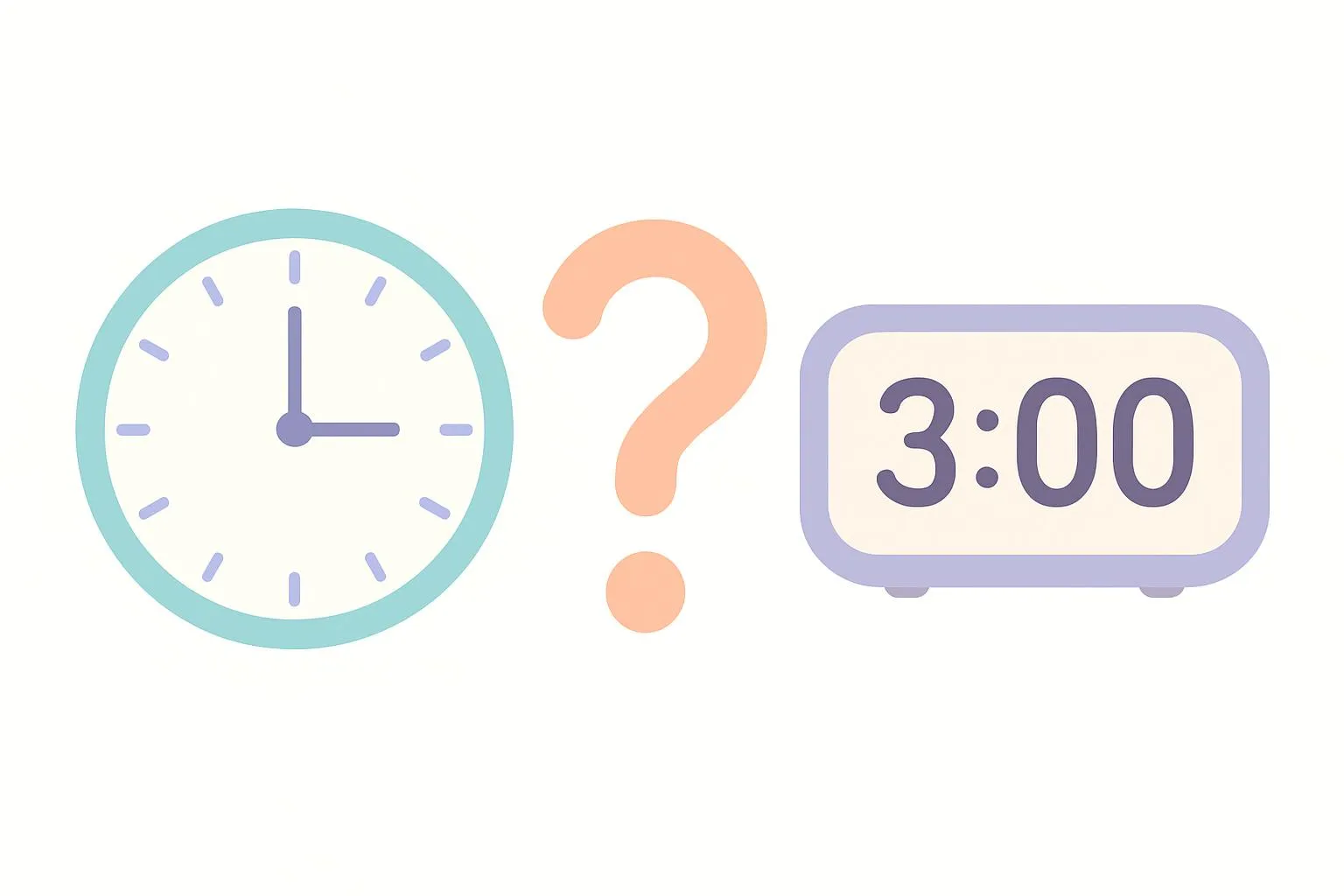
The Great Debate: Analog or Digital First?
One of the most common questions educators and parents ask is: "Should I teach analog or digital clocks first?" This decision can significantly impact how children develop their understanding of time. Let's explore both approaches and help you make the best choice for your students.
Understanding Analog Clocks
Analog clocks are the traditional circular clocks with hour and minute hands. They've been teaching time for centuries and offer unique educational benefits.
Advantages of Teaching Analog First:
- Visual Representation of Time: The circular face helps children visualize time as a continuous cycle, not just numbers
- Mathematical Concepts: Teaches fractions (quarter past, half past), angles, and circular measurement
- Spatial Reasoning: Develops understanding of position, direction, and relationships
- Problem-Solving Skills: Requires more cognitive processing to read, strengthening mental math
- Universal Skill: Analog clocks are still widely used in schools, homes, and public spaces
Challenges with Analog Clocks:
- More complex to understand initially
- Requires understanding of two different hands moving at different speeds
- Can be confusing when the hour hand is between numbers
- Needs prerequisite skills like counting by fives
Understanding Digital Clocks
Digital clocks display time in numerical format (e.g., 3:45). They're increasingly common in our digital world.
Advantages of Teaching Digital First:
- Simplicity: Direct number reading without interpretation
- Immediate Accuracy: No ambiguity about the exact time
- Modern Relevance: Matches what children see on phones, tablets, and computers
- Quick Mastery: Children can read digital time faster with basic number recognition
- Less Confusion: No hands to mix up or positions to interpret
Challenges with Digital Clocks:
- Doesn't teach the concept of time passing visually
- Misses important mathematical connections (fractions, angles)
- Limited understanding of "quarter past" or "half past" concepts
- Doesn't develop spatial reasoning skills
- May struggle when encountering analog clocks later
Research and Expert Recommendations
Educational research provides valuable insights into this debate:
The Consensus: Most education experts recommend teaching analog clocks first, then introducing digital clocks as a complementary skill. Here's why:
- Cognitive Development: Analog clocks provide richer learning experiences that develop multiple cognitive skills simultaneously
- Mathematical Foundation: Understanding analog time builds fraction concepts that are crucial for later math learning
- Transferable Skills: Children who learn analog first can easily transition to digital, but the reverse is more challenging
- Standardized Testing: Most educational standards and tests focus on analog clock reading in early grades
The Recommended Teaching Sequence
Phase 1: Analog Foundation (Grades 1-2)
Start with analog clocks to build a strong conceptual foundation:
- Whole Hours: Begin with the hour hand only (1:00, 2:00, 3:00)
- Half Hours: Introduce the minute hand at the 6 (1:30, 2:30, 3:30)
- Quarter Hours: Add 15-minute intervals (quarter past, quarter to)
- Five-Minute Intervals: Progress to counting by fives around the clock
- One-Minute Precision: Finally, teach reading to the exact minute
Practice Tool: Use our clock worksheet generator to create progressive analog clock exercises at each level.
Phase 2: Digital Introduction (Grade 2-3)
Once analog skills are solid, introduce digital clocks:
- Format Introduction: Show how 3:00 on analog equals 3:00 on digital
- Reading Practice: Practice reading digital times aloud
- Conversion Skills: Match analog and digital times
- Real-World Application: Identify digital clocks in daily life
Phase 3: Integration (Grade 3+)
Combine both formats for comprehensive understanding:
- Practice converting between analog and digital
- Use both formats interchangeably in problems
- Apply time-telling to real-world scenarios using both types
- Introduce elapsed time calculations with both formats
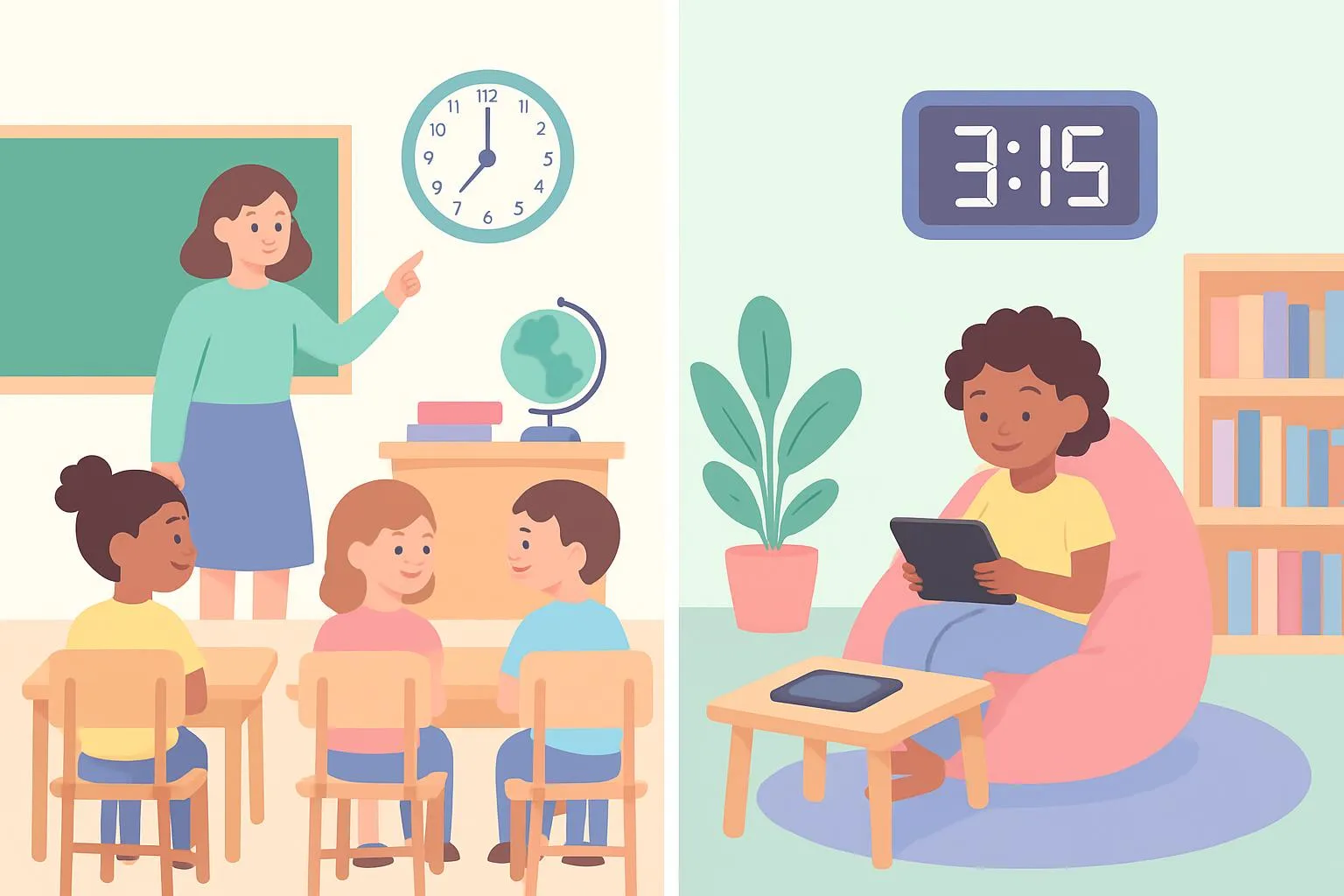
Special Considerations for Different Learning Styles
Visual Learners
Analog clocks are ideal for visual learners because they can see time as a spatial concept. The movement of hands provides a visual representation of time passing.
Strategy: Use color-coded clock hands and large demonstration clocks to emphasize the visual aspects.
Kinesthetic Learners
Hands-on clock manipulation benefits kinesthetic learners. Analog clocks with movable hands provide tactile learning opportunities.
Strategy: Provide individual student clocks they can manipulate. Create "human clocks" where students act as the hands.
Auditory Learners
Both clock types work well for auditory learners when paired with verbal explanations and time-telling songs.
Strategy: Use rhymes and chants: "The short hand shows the hour, the long hand has the power to show us every minute of the day!"
Addressing Common Misconceptions
Misconception 1: "Digital is easier, so teach it first"
Reality: While digital clocks are easier to read initially, they don't build the conceptual understanding children need for advanced time concepts and mathematical reasoning.
Misconception 2: "Kids don't need analog skills in the digital age"
Reality: Analog clocks are still prevalent in schools, homes, and public spaces. More importantly, learning analog time develops crucial mathematical and spatial reasoning skills.
Misconception 3: "Teaching both simultaneously is more efficient"
Reality: Teaching both at once can confuse young learners. A sequential approach allows mastery of one format before introducing the other.
Practical Implementation Strategies
For Classroom Teachers:
- Week 1-4: Focus exclusively on analog clocks (whole hours)
- Week 5-8: Continue analog practice (half hours, quarter hours)
- Week 9-10: Introduce digital clocks as a "translation" of analog
- Week 11+: Practice both formats with emphasis on conversion
For Parents at Home:
- Place an analog clock in your child's room
- Practice reading the analog clock during daily routines
- Once comfortable, point out digital clocks and compare
- Use both types naturally in conversation
Assessment and Progress Monitoring
Track your students' progress through both formats:
Analog Clock Mastery Checklist:
- ☐ Can identify all numbers on clock face
- ☐ Recognizes hour hand vs. minute hand
- ☐ Reads whole hours accurately
- ☐ Reads half hours accurately
- ☐ Reads quarter hours accurately
- ☐ Reads five-minute intervals
- ☐ Reads time to the minute
Digital Clock Mastery Checklist:
- ☐ Understands the colon separates hours and minutes
- ☐ Reads digital time correctly
- ☐ Converts analog to digital
- ☐ Converts digital to analog
- ☐ Understands AM/PM notation
Technology Integration
While teaching analog first, you can still leverage technology:
- Interactive Whiteboards: Display large analog clocks for whole-class instruction
- Tablet Apps: Use apps that focus on analog clock reading with immediate feedback
- Online Generators: Create custom worksheets with our free generator
- Digital Comparisons: Use side-by-side displays showing both formats once ready
Cultural and Global Perspectives
Different countries have varying approaches to teaching time:
- United States: Strong emphasis on analog clocks in elementary curriculum
- United Kingdom: Analog-first approach with systematic progression
- Asian Countries: Often teach both simultaneously but with analog emphasis
- Scandinavian Countries: Integrated approach with heavy use of visual aids
Despite regional differences, the analog-first approach remains the global standard in elementary education.
Conclusion: The Verdict
While both analog and digital clocks are important, teaching analog clocks first provides the strongest foundation for time-telling skills and mathematical development. The sequential approach—mastering analog, then introducing digital, then integrating both—offers the best outcomes for most students.
Remember: the goal isn't just to read time, but to understand it. Analog clocks provide the conceptual framework that makes all future time-related learning easier.
Your Action Plan:
- Start with analog clock instruction using whole hours
- Progress systematically through half hours and quarter hours
- Introduce digital clocks once analog skills are solid
- Practice conversion between both formats
- Use real-world applications with both clock types
Recommended Reading
- Digital Tools vs Traditional Methods for Teaching Time
- Best Clock Teaching Tools for Classroom Success
- Visual Aids for Teaching Time: What Works Best
- 📖 Complete Teaching Guide: How to Teach Children to Tell Time
Ready to start teaching? Generate custom analog clock worksheets with our free worksheet generator and begin building strong time-telling skills today!